Can We Know Something Only by Using Our Mind?
I often think about how much we can trust our own reasoning. We are taught that the mind alone is not reliable. Science asks for experiments and evidence, religion asks for faith, and both warn us about the limits of pure thought. Still, every idea begins in the mind, whether we like it or not.
I also believe I am a fairly sharp ideator and thinker. But that often feels like a trap. As an example, I have spent a lot of time thinking about prayer as an exercise. I grew up performing namaz, the Turkish word for Islamic prayer, sometimes regularly, sometimes not at all. Even when I was less religious, I kept thinking about it. Why these movements exist, why they are repeated, and what they actually do to a person beyond their religious meaning.
As I kept learning and reading, my brain started catching patterns in repetitive movements, rituals, and ancient religious cultures.
Finally, this year, while reading about yoga and Buddhism, I noticed something that felt almost embarrassingly obvious. The physical structure of namaz and yoga is very similar. Standing, bowing, prostrating, sitting on the ground, repeating the same sequence again and again. Yoga has a much wider range of movements, but the core idea feels familiar.
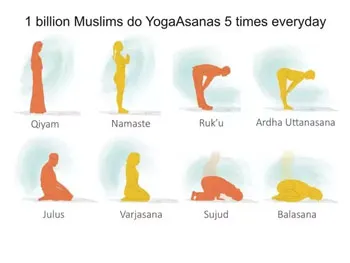
I am not saying they are the same practice or that they come from the same belief system. Spiritually and historically, they clearly belong to different worlds. But on a bodily level, they seem to serve a similar purpose. They slow you down, force attention on posture and breathing, and pull you out of daily noise for a few minutes.
I did not arrive at this thought through research. I did not read academic papers or trace historical connections. I simply noticed it. That made me uncomfortable in a good way. Was this something real, or was I just creating a pattern because my brain likes patterns?
As I keep reading, I am at least sure of one thing: the similarity itself is obvious. But it is hard to find a clear, unquestionable truth about its origin. This is also a tricky area of human culture and religion, where taboos easily appear.
That question brought me back to the main issue. Can a person reach something true using only their mind? I think sometimes yes, but only partially. The mind can point toward something meaningful, but it cannot finish the job on its own. Proof, context, and confirmation come later, if we decide to look for them.
For me, this realization did not prove anything historically. It simply changed how I see salat. It made it feel less abstract and more human. Different cultures, different names, similar bodies, similar needs. That alone was enough to matter.
Further reading
https://kashmirlife.net/yoga-versus-salah-81162/ https://www.iyc-yoga.org/islam&yoga.html (Image taken from this site)